How do Females fare in the SA Retail Market?

Author: Eben Esterhuizen


While we focus on women in South Africa during the month of August and honour our constitution for declaring the 9th of August a public holiday, retailers continue to look closely at the overall economic status of women.

How liquid is the average women consumer? What does she buy? Does she have the buying power in a household and what does that household look like?

Customer behaviour should drive retail

Segmenting customers, particularly women, in a country as unequal and diverse as South Africa is far from simple, in fact, the data specific to the FMCG female customer is sparse.

This is felt in the retail detail and shopper marketing spheres, as Liezel Matthee, head of analytics and consulting at IRI South Africa notes: “In South Africa, we have found that retailers and manufacturers are extremely good at measuring results, but not as good at measuring the drivers. Shopper data drives all the results that we’re measuring – it tells us the ‘why’.”

How are women in South Africa doing?

Out of South Africa’s 57.7 million people in 51% are female. And women live, on average, six years longer than men, with a life expectancy of 67.3 years compared to 61.1 years for men.

Stats SA’s article, How do women fare in the South African labour market? notes, “The rate of unemployment amongst women was 29,5% in the second quarter of 2018 compared with 25,3% amongst men.”
They state that women are more likely than men to be involved in unpaid work and of the informal sector (which accounts for 17,4% of total SA employment) 47,6% are women compared to 30,6% of men. Clearly, times are tough.

Spending overview

South Africa’s Gross Domestic Product (GDP) was worth $349.42 billion in 2017 (substantially up from $295.76 billion in 2016) and consumer spending in South Africa increased to R1,936,072 million in the first quarter of 2018 from R1,928,878 million in the fourth quarter of 2017. But, employment growth slowed in the first quarter of 2018, with most of the limited job creation happening in the informal sector.

Household consumption

On average a South African household will generally consist of three to four people and have an income of R138,268 per year, with an annual expenditure of R103,293. Male-headed households have a higher average annual income than their female counterparts – R165,853 and R98,911 respectively – and therefore, have greater spending power than female-headed households.

Other statistics to bear in mind are that South Africans spent R31,900 per second in retail stores in 2017 and of our population of over 57 million, just under 31 million people are currently using the internet.

Women earn less but pay more

In a recent survey done by Sanlam some interesting findings emerged with regards to women’s regular spend; the stats aren’t conclusive, but indicative, as Danelle van Heerde, head of advice processes at Sanlam Personal Finance says, “To drastically oversimplify the situation, women are generally earning less and paying more.”

In the survey, 98% of women say they spend more than R100 on monthly toiletries and only 23% of men do. Some of the items listed are:

• Basic toiletries
• Grooming products
• Medical screenings

Of the 500 women and 500 men surveyed, additional findings include:

• Women spend over R1,500 a year on medical screening, versus only 1.2% of men.
• The majority of men, at 56.4%, spent nothing on contraceptives.
• 51.2% of women purchased contraceptives monthly, with 30% of them spending more than R100.

The suggestion by Sanlam was that these discrepancies between spend came down to “pink tax”, which is gaining traction through the #Axethepinktax movement.

The future

According to Gareth Paterson, Nielsen retail vertical lead, South Africa has added 100,000 new traditional trade (e.g. spaza) and modern trade (hypermarkets, supermarkets) stores to its retail world in the last two decades.

Nielsen describes the growth of the spaza shop as “exceptional”, with an increase from 45% to 53% of South African modern trade shoppers (2015 vs. 2016) who now also utilise spazas. Since women are the majority of people occupying the informal sector it would add up that they are the ones predominantly shopping at the Spaza shops.

Nielsen also reports that by 2025 the South African population will have increased by 6% (approximately 3 million people) with notable workforce changes because more than 4.3 million women will have entered the job market by then. With this in mind, retailers need to be prioritising product, price and ease of purchase for women who will be even more prominent when making purchasing decisions in the future.

As retailers, it would be prudent for us to get to know the different types of female consumer better – from the estimated 11.5 million people who are part of a stokvel to the other end of the spectrum, the woman heading towards a totally online shopping lifestyle and those in between. One thing we do know for sure is the future of South Africa is young and female and that’s an exciting prospect for the local FMCG space.

Author: Eben Esterhuizen

The Bright Side: Why Women Fell Out of Love with Black

Author: Hannah Marriott

For decades it has been synonymous with timeless chic – but now joyful, attention-grabbing colours are pushing it out of the wardrobe.

New Yorkers do it. Parisians do it. Fashion types, Swedes and architects do it. In fact, name any stylish tribe and you’ll find that they do it. Wear black, that is – a colour that has come to signify so much: rigour, elegance, sex appeal, piety, formality, slenderness, even wickedness.

Recently, however, black’s supposedly timeless status as the go-to hue for the chic has been thrown into the shade. And maybe that is no bad thing.

Scroll through any British fashion website today and a rainbow of colour beams out. The breadth of shades feels remarkable: Topshop sets out its stall with a parrot-green silk skirt, a lemon coat and an azure trouser suit. At Boden, it’s all tomato-red cardigans and spotty cerise frocks. At Zara, there are russet and emerald tartans and rollneck jumpers in highlighter pen yellow and candy pink.

Yes, Britain is in the midst of a heatwave, but this is no seasonal aberration. For months, the fashion news agenda has been hijacked by colour, seen everywhere from Amal Clooney’s dandelion-yellow royal wedding frock to Janelle Monáe’s so-called “vagina” trousers (pink, of course).

Colour is hot, and the trend forecaster WGSN has the data to prove it. In January, it says, brightly coloured clothes represented a 20.2% share of the UK market, up from 16.7% two years previously. Meanwhile, between April 2017 and April 2018, black fell by 10%. Yellow has performed spectacularly, up 50% year on year. Another retail analyst, Edited, has a different take, but one which is nevertheless telling. Though it reports that the overall ratio of black clothing sold is up, the shade has slipped out of the fashion spotlight, falling by 2% this year within “best-selling products – the stuff that sells out fast”, according to the retail analysis and insights director Katie Smith.

Black is not dead, but Florence Allday, Euromonitor International’s analyst, predicts it will become an “increasingly smaller proportion of retailers’ product offering”, thanks to shifts in our lifestyles. “Now your office can be anywhere, the boundaries between formal/informal, work/home, online/offline are blurring,” she says. “Colour is no longer seen as frivolous, eccentric or inappropriate.”

Colour is going nowhere for autumn, when the trends set to trickle down from the catwalk include neon and hi-vis. And this is not just for the very young or achingly hip: the philosophy behind John Lewis’s biggest womenswear relaunch in decades, on sale in September, is about using colour as a means for expressing individuality, with most items available in up to four hues.

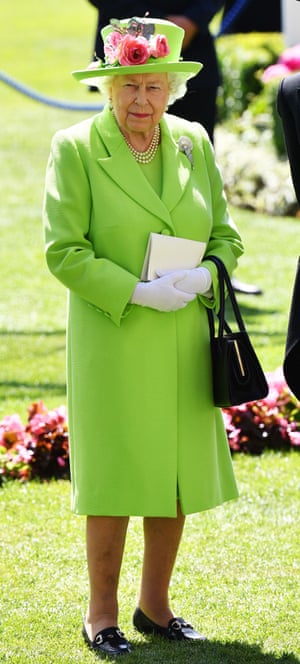
The professionally seen-and-not-heard have used colour cannily for decades. The Queen, for one, dresses brightly to ensure visibility. Recently, she has noticeably ramped up the intensity, dabbling in head-to-toe lime green and shocking chartreuse.

The Quuen at this year’s Royal Ascot.
The Queen at this year’s Royal Ascot. Photograph: Tim Rooke/Rex/Shutterstock

Such expert tricks are becoming part of civilian wardrobes, too, thanks to social media, and what Smith describes as “millennial peacocking”. She says: “It’s the fastest way to stand out on an endlessly updating feed.”

Instagram stars are virtuoso colourists. The Danish street style star Pernille Teisbaek, for example, is an icon for what passes as understated chic now. Although monochrome makes up a significant part of her feed, she uses colour when it counts. On the cover of her recent book, Dress Scandinavian, for example, she wears mustard trousers, a canary-coloured jacket and a T-shirt with the word “yellow” over a picture of a bunch of bananas, an image which kills dead the idea of navy-and-cream Scandi minimalism.

As the internet threatens the future of the traditional high street, the niche brands flourishing online have colour at the centre of their business plans. Kitri, for example, has seen products such as its £145 grass green Gabriella dress go viral. When the company launched, in March 2017, founder Haeni Kim says: “There was more of that traditional retail sense of putting more quantity behind neutrals. Now, we have started phasing out neutral colours, which is very unlike the traditional rules.” Bright colours, she says, “make people feel special. They get such amazing compliments. They photograph well on our website, and also stand out when customers take photographs of themselves. We are living in a very photographed world.”

Even vampires don’t wear much black these days, according to Susie Cave, the wife of musician Nick, whose label, the Vampire’s Wife, has quickly captured the fashion zeitgeist. The brand’s name, which was always meant to be ironic (“You know, my husband has been held hostage by the Prince of Darkness thing for years,” she says), might suggest a Morticia Addams palette – but the emphasis is on peaches-and-cream florals and deep shimmering greens.

“I think the world in which we live as women has become so divisive, so bloodthirsty, so vindictive and puritanical that women want to exist beyond these reductive influences, and colour is one way of doing this,” says Cave. “Colour has a huge positive psychological impact – it is a shout of individuality – and I think women want some life and wonder and joy and wildness in their lives and colour gives them that.”

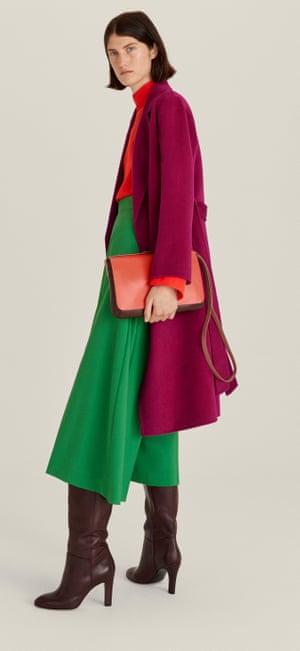
John Lewis’s biggest womenswear relaunch in decades is about using colour as a means for expressing individuality.

Cave is far from alone in using emotional language about colour. In fact, one of the most fascinating shifts in our approach to colour is the way we talk about it. In the 90s, colour analysis meant finding out if you were “cool autumn” or a “warm spring” in order to buy a jumper that would make your eyes sparkle. Now, colour chat rarely mentions appearance, but is about politics, identity and mood.

In 2016, the term “millennial pink” was coined to describe a shade said to encapsulate the moment’s “ambivalent girliness”. Since then, as the fashion blog ManRepeller wrote in May, colour has become clickbait. Other shades with catchy names – among them “Gen Z yellow” and “melodramatic purple” – have also been briefly posited as generation-defining, while bright colours are increasingly used for protest, from pink pussy hats to calls to wear red for International Women’s Day, or green for Grenfell or orange for gun safety.

WGSN’s colour director, Jane Boddy, believes we are all increasingly aware of “how colour connects us, as human beings, and how we use it as a tool to define us”. Certainly, a fascination with something as digestible as colour makes sense when the news agenda is so tangled and baffling, thanks to Brexit and Trump.

We may be living through the most visual era ever. But at least fashion experts are no longer urging women to wear black clothing to look thinner or less distracting in the workplace.

Issues of class and gender swirl around black dresses like clouds of chiffon. Black has been linked with money and taste since the 1500s. In the Victorian era, it was a signifier of mourning, and scandalously worn by women of loose morals in paintings, including Manet’s A Bar at the Folies-Bergère and John Singer Sargent’s Madame X. The pivotal moment, however, for black as we know it was Coco Chanel’s little black dress, a simple, long-sleeved, straight-up-and-down shift hailed, on a 1926 Vogue cover, as the fashion equivalent to Ford’s Model T, “a sort of uniform for all women of taste”.

The reality of Chanel’s LBD was far less progressive than the mythology suggests. According to Shelley Puhak, writing in the Atlantic: Chanel’s innovation was an appropriation of servant’s uniforms, part of the luxurious poverty – “la pauvreté de luxe” – trend “reserved exclusively for those who could ‘afford’ to look poor by pretending that they simply couldn’t be bothered with fashion. But on closer inspection, there would be some small detail in her seemingly anonymous garment – a certain cut or fabric or label – that acted as a secret handshake for those in the know.” Plus ça change.

Audrey Hepburn in a black Givenchy shift in the 1961 film Breakfast at Tiffany’s.
Audrey Hepburn in a black Givenchy shift in the 1961 film Breakfast at Tiffany’s. Photograph: Allstar/Paramount Pictures

Little black dresses have since become a cultural totem. They can launch careers (Liz Hurley and her safety pins) and wreak revenge (Princess Diana at the Serpentine Gallery party in 1994). Their icons are usually very sharp and very thin. The patron saint is Audrey Hepburn in a black Givenchy shift in Breakfast at Tiffany’s or a black beatnik rollneck in Funny Face. Other notable black dress icons include the quartet of grumpy glamazons in the video for Robert Palmer’s Addicted to Love.

Black is not very friendly. So many of the aphorisms that exist about the shade have a hectoring tone: “A woman without a little black dress, has no future,” said Coco Chanel. Black, according to the Japanese designer Yohji Yamamoto, says: “I don’t bother you. Don’t bother me!” Karl Lagerfeld, of course, thinks wearing black is much safer than dressing according to your own terrible taste. “If you’re wearing black, you’re on sure ground.” And behind it all is the pernicious idea that black matters because, as Christian Dior put it: “It is the most slimming of all.”

So, is black a feminist issue? Susie Orbach says black has been “coded” as elegant, but often this really means slimming. “You could go back to Breakfast at Tiffany’s, the image of the gamine, cute sophisticate in the black dress. What’s in that is skinny, which, of course, has been absolutely critical to the representation of femininity for years.”

At a time when body image issues are worse than ever, according to Orbach, dancing on black’s grave is probably not merited. “There is no bloody difference when you are talking about clothing,” she says. “It’s still about: ‘How do I represent myself?’ There is always an internal eye that’s judgmental, whether the current trend is that you need to stand out, rather than look svelte and sophisticated. It’s the same thing, just a different version of it. It strikes me as a wish too far, frankly.”

Naomi Wolf, the author of The Beauty Myth, is a little more optimistic. “If women are embracing colour, it suggests that they are confident they can be taken seriously without wearing black,” she says. “If people aren’t choosing clothes primarily to appear smaller, I think that’s really politically important. It says: ‘I’m here and I’m not ashamed.’ It’s very non-apologetic.” And that’s an argument that I can buy into. After all, we may as well look on the bright side.

Author: Hannah Marriott

Décor brand Something Desired launches kiddies’ range

Article found on BizCommunity

Something Desired, the online custom décor arm of events design concept Something Different, has launched a kiddies’ collection. The range is made with baby, toddler and tween in mind and is called MIA – an Acronym for Maria, Imogen and Archie.

“This range was really true to my heart. We have developed many products, designs and ranges but this one was not just born out of prettiness and necessity but out of experience, out of hindsight and out of knowing that these pieces would be important to mothers and families. Both Nelia (our designer) and myself have children and this was a true collaboration, so I felt to honour her she needed to be a part of the ranges name as well. These products were shaped from our own experience with our kiddies, therefore we felt they needed to head up the ranges key name,” says Kate Shepherd, founding owner of Something Different and Something Desired.

Shepherd is a mom of two (3.5-year-old girl; 7-month-old boy) and a businesswoman who understands the importance of good quality furniture that is both functional as well as useful and has longevity. With the launch of their kiddies range, each piece is made to be used for years to come.

Practical and whimsical

Among the nursery range is a versatile olive green velvet daybed, an all-in-1 compactum – including a changing surface, storage and bath unit – and custom designed lights in organic shapes and textures.

Décor brand Something Desired launches kiddies' range


When it came to creating a unique table and chairs combo, Shepherd looked to her daughter, Imi, for inspiration. “Years ago, I designed a set of Bunny Chairs and a matching table set for my daughter, she is 3 years old now and still loves it. She eats, draws and entertains friends around it. I wanted her to be part of our dining and living space, but wanted to opt for something that matched and enhanced our home décor.”

With this in mind, Something Desired added a set of little animals’ stools and table set to their collection.

Décor brand Something Desired launches kiddies' range


In the kiddies beds category, Shepherd decided on a whimsical single bed frame for girls with soft drapes, twinkling fairy lights, and a large built-in drawer underneath for either another mattress or storage. While for boys, the Something Desired team opted for an adventure theme with a glamping-styled bed design.

Décor brand Something Desired launches kiddies' range

When it comes to additional décor items, there’s a redesigned blackboard for doodling and design, as well as bookshelves and cushion covers.

Article found on BizCommunity

E-commerce Misconceptions and how SA Sports Organisations can do better

Sport remains big business in South Africa but like all other industries, it is rapidly getting disrupted by technology advances. Globally there is an accelerating trend towards online commerce as it becomes an urgent priority for brands, yet local sports bodies continue to lag behind, losing out on lucrative fan spend and desperately needed revenue.

Global trends show soaring online sales growth

In the United States, many traditional brick-and-mortar shops are going out of business as big e-commerce operations such as Amazon and Walmart offer consumers unsurpassed convenience and choice.

Brands like Adidas are closing stores in order to double their e-commerce sales as they saw online sales jump 60% in 2017. Adidas CEO, Kasper Rorsted, recently stated: “Our website is the most important store we have in the world.”

Local brands not in the starting blocks

According to Statista, there are currently 18.43 million e-commerce users in South Africa, with an additional 6.36 million users expected to be shopping online by 2021. Revenue in 2018 is estimated at R42bn with an annual growth rate of 13.7%.

The big three in sports – soccer, rugby and cricket – hold in their hands a nation of sporting fans, who for the most part can only purchase branded gear in-stadium at a game or at a limited selection of sports stores. A few online shops are popping up but for the most part, large sporting bodies are missing out on a valuable revenue model. Even smaller sporting organisations could benefit from decent additional revenue if they invested in their e-commerce potential.

So why is there such a disconnect and poor take-up by South African sporting organisations? Let’s have a look at the misconceptions and some e-commerce truths.

An online store is not easier than a brick-and-mortar store

The biggest misconception is that operating an e-commerce store is easier and less complicated than a traditional brick-and-mortar establishment, but actually, the same problems and hurdles are encountered but in a different way.

Customer footfall, staff, marketing and cost to build are some of the basic considerations when building a physical store, yet when brands plan their online shop with a catchment area that spans the whole country, budgets are minimal, and staff and marketing planning is non-existent. An online shop needs to be treated the same way as a brick-and-mortar shop.

Rent money becomes marketing spend

With a normal store, position is key – the better the location, the higher the footfall and customer LSM, the steeper the rent. When an online store goes live, it basically exists in some far corner of the internet and no one knows you are there. That money that you would normally spend on rent must now be spent on marketing. In order to get customers, you will need to create sales and promotions and advertise on Facebook and Google.

With a traditional shop, you rely on the shopping centre to get footfall, with e-commerce, your marketing gets footfall.

An online store needs staff

An online shop does need people to look after specific responsibilities. If it is a small concern, you can do it yourself, but as you expand you will need people handling operations, marketing, sales, fulfilment and support.

You can outsource your marketing to an agency and you can also get a warehousing and order fulfilment service like Parcel Ninja to handle your operations. These operations services can warehouse all your goods, pick, pack and ship and they are safe and secure at a relatively low cost.

Launch as a lean start-up

To begin, you take your minimum viable product that will have the most impact, determine how long it will take to build and get selling online. That first push needs no bells and whistles, the point is to get you out and selling.

An online store is adaptable to circumstances and customer needs, unlike a brick-and-mortar shop, and can take advantage of that to succeed. From the moment you launch online, you can do backend renovations and keep upgrading, even on a weekly basis if necessary.

Get going!

E-commerce is not a new market in South Africa. Everyone has made an online purchase even though they might not be aware of it. Plane tickets, music concerts, even an airtime purchase is e-commerce. The market is mature and growing yet we continue to see huge gaps with sports brands and organisations that are coming late to the game.

Creating and activating a successful omnichannel strategy with inventory integration, order fulfilment and top-end customer service is obtainable with the right approach. E-commerce lets your sports brand reach more fans, faster, and easier than ever before, unrestricted by the constraints of 8 to 5 brick-and-mortar. It’s an always-on, 24/7 economy that offers massive rewards.

There’s no time like the present.

For a free consult, contact Sportal: info@sportalonline.com

Sportal offers turnkey digital solutions to enable sporting organisations to monetise their content and drive revenue.

Why Africa’s Clothing Sector could lead in Responsible Sourcing

Author: Lauren Hartzenberg


Whether you are a retailer, brand or manufacturer, the need to proactively manage social compliance issues in your supply chain has never been greater. Social compliance matters first and foremost because it’s the moral way to run a company, but the business benefits cannot be ignored either.

These were the sentiments of Gerwin Leppink, Europe representative at Worldwide Responsible Accredited Production (Wrap), an independent certification programme operating in the apparel, footwear and textile sector. He was speaking on the topic ‘How responsible sourcing applies to Africa’ at the recent Source Africa trade show held in Cape Town.

Reputation matters

“The world is watching. Information moves around the globe in seconds – both positive and negative – and it can impact a business’s reputation,” he said.

Consumers are watching, and so are governments and consumer protection bodies. There are now dedicated organisations helping shareholders understand just how socially responsible supply chains are for companies they’re looking to acquire shares in. Government arms, in Europe and USA especially, have growing concern for what’s occurring in garment and textile supply chains, he noted.

And today’s younger consumers have higher expectations of the ethical side of a product and its production environment.

Africa’s opportunity

“For us in apparel supply chains, reputations lie at factory level, retail and brand level but also country level,” stated Leppink.

Working off Africa’s relatively clean slate in terms of responsible sourcing, Leppink believes the continent is faced with the opportunity to build a competitive advantage with strong supply chain systems from the very beginning.

“I think there’s an opportunity for Africa to be proactive and not become Asia from ten years ago.”

He referenced Bangladesh’s Rana Plaza collapse in May 2013 which claimed more than 1,000 lives, and 2012’s Ali Enterprises factory fire in Pakistan in which over 250 workers died. The former was the result of a structural failure as the building was not suitable to house a factory and lacked the correct safety certificates, while in the latter escape routes were blocked preventing workers from reaching safety.

“Africa has a neutral reputation. Now is the time to put practices in place to avoid horrors like these if business in Africa is going to grow. Africa has a clean slate. Keep it clean.”

The business case for compliance

Beyond the moral obligation, social compliance is vital for risk management and business continuity. It protects your organisation to be able to work sustainably.

Leppink said there is a definite need for self-assessment in factories and the introduction of policies and procedures as part of a sustainable business model.

Social compliance is not free of change – it costs time, resources and money. But there is a return on cost, and therefore should be viewed as an investment. He advised that verification be approved before starting to do business, to protect yourself from the inevitable trial and error.

“Social compliance requires a systematic approach from management – you’ll have more efficient production if you work in a compliant way. Workers are happier and have better output if they work in an ethical environment.”

Best practice

In terms of best practice, he said that compliance needs commitment from leadership and it needs to be a sustainable effort, not a lucky shot. It demands effective management on a consistent basis.

Continuous training for all employees is also key to compliance, as are supportive documentation. Are there safety procedures in place? Do workers know what to do if there is a fire?

“Best practice is very simple. Know as much as you can about the facilities where production is occurring. This applies to retailers, brands and manufacturers themselves. Think ‘what would the buyer want to see in order to do business with my company,’” said Leppink.

He concluded, “Verifiable, responsible sourcing practices have become a global sourcing imperative and an increasingly important aspect of supply chain management in today’s value chain.”

Author: Lauren Hartzenberg

The Four Trends Impacting the Global Fashion Industry in 2018

fashion industry trends 2018

Author:


Over the last five years, the fashion industry has felt the same pangs as the rest of the retail world. However, unlike some industries, there have been bright pockets. Apparel brands, especially those with fast fashion or direct-to-consumer models, that have been able to quickly innovate to meet consumer needs have seen success.

At Bazaarvoice, we have a client base of over 5,700 brand and retailer websites, a large number of which are in the fashion and apparel space. As an Account Director on our Client Success team, I partner with some of our largest global retailers. Along with the rest of our Client Success and Sales teams, I work closely with our clients to understand their goals and pain points. Because of this, we have deep insight into industry trends. To get a broad understanding of trends impacting our fashion and apparel clients, I reached out to Client Success and Sales team members across the organization. What were their clients’ concerns for 2018? How are they trying to innovate in the year ahead? Based on that insight, these are the four fashion industry trends to stay on top of in 2018. 

fashion industry trends 2018

Staying competitive in a uniquely crowded market

Competition is a concern for any business, regardless of industry. But today’s retail environment is particularly challenging. Not only do brands have to adjust to changing consumer trends and preferences but also to an industry with a wide variety of players, including fast fashion, direct-to-consumer, and Amazon.

Account Executive Austin Rindner says, “There is a ton of increased competition in apparel. High end apparel brands are facing significantly more competition from fast fashion and other cheaper alternatives. Amazon is starting to dip the into the apparel space, which is another concern.”

Fast fashion brands like H&M, Zara, and ASOS have disrupted the industry by meeting a previously untapped consumer need — on trend clothing and accessories for a lower price. These brands can turn around new products in fewer than six weeks from conception to shelf, and their success is forcing the rest of the fashion world to keep up. According to McKinsey’s 2018 State of Fashion report, “sales of the traditional fast fashion-sector have grown rapidly, by more than 20 percent over the last three years.”

In 2018, fashion brands have prioritized innovation to stay competitive with consumers who expect trendy inventory. Mandy Oettmeier, Client Success Director, says that “increasing efficiencies and productivity within inventory management and supply chain” is a major focus area for many of her fashion and apparel clients.

When talking about competition, it would be remiss not to mention Amazon. Over the last year, the e-commerce giant has made a lot of moves to expand its reach, including acquisitions and forays into new markets. Andy Fryer, an Account Executive in our Asia-Pacific region, said, “Amazon just launched here in Australia. It’s not really a massive threat to fashion and apparel right now, but only time will tell.”

In addition to new markets, Amazon has been breaking into new verticals and has recently begun to make more aggressive moves to establish itself in the apparel space. The company has quietly rolled out its own fashion lines over the last two years, but, in late 2017, it branched out from basics with a trendier line called Find and its own athletic apparel collection, Goodsport. Austin added that, “Alexa has started to offer fashion advice like a personal wardrobe consultant. This gives Amazon even more direct insight into their customers that traditional brands and retailers struggle to access.” Just recently, Amazon announced that it was increasing its fees for the clothing and accessory category, making apparel the most expensive category to sell on Amazon.

The fashion industry is uniquely competitive, and that doesn’t show signs of changing anytime soon. Brands that don’t innovate fast enough will be left behind. 

fashion industry trends 2018 omnichannel

Delivering a seamless experience across all consumer touchpoints

Omnichannel — the concept of integrating all of your consumer touchpoints (social media, brick-and-mortar, online, mobile, etc.) to provide a seamless customer experience — has dominated industry conversation for the last five or so years. A headline of a Forbes article last year asked, “Can We Stop Saying Omnichannel And Just Say Retailing?”. While we might be tired of hearing the word, omnichannel should be table stakes for fashion brands. However, the reality is that many still struggle to figure it out.

Many of our fashion and apparel clients have prioritized providing an omnichannel experience for 2018. But first, to be able to do this, they need to get a grasp on their customers. In conversations with our clients, there was a desire to better understand their customers, especially a holistic view outside of their own properties. This means getting a handle on customer data. Technological innovation has given brands the opportunity to collect mass quantities of customer data, but the problem becomes making sense of it and putting it to work in the right way.

Brick-and-mortar, online, social media, mobile, and customer service are major customer touchpoints, and, therefore, major priorities for any omnichannel strategy. Our different apparel clients are focused on different areas. For example, Ashley Knowles, Client Success Director, says that “while one client is working towards a successful mobile app launch, another is trying to improve their in-store experience, and both see a truly omnichannel experience as a priority.” Similarly, Mandy says her fashion clients want to “accelerate their online and mobile businesses, try to meet customers where they are, better manage big data, and deliver buy online, pick up in-store and order in-store options.”

Whether focused on improving one particular channel or the journey as a whole, it’s clear from talking to many brands and retailers in the fashion industry that a seamless customer experience is still a goal that many are working towards.

fashion industry trends 2018 competition loyalty

Fostering brand loyalty with customers who have infinite choices

Once you reach and convert customers, how do you keep them? The rapid innovation and growth in the fashion industry has created new standards in retail, but, more importantly, it’s created new standards in consumer expectations. Shoppers can choose from a never ending list of brands and products. In addition to competing for new customers, fashion brands are investing in ways to keep the customers they have.

There are a variety of ways that today’s fashion brands foster loyalty — social media, rewards programs, mobile apps, discounts — but if you don’t have a memorable, quality product, you will lose customers right away.

The issue of returns is particularly challenging for the fashion industry, as customer experience relies heavily on fit. 80% of first time customers who experience a return will never shop at that retail website again. Carla El Gawly, Account Director for many of our European fashion clients, reinforced that the high rate of returns in fashion, particularly for e-commerce, remained an issue for her clients and results in major hits to sales and loyalty. Many retailers say that 20-40% of their online sales are returned, with fit being the #1 reason. On the flip side, 85% of consumers saying they go back to a brand specifically because of how it fits them. One way I have seen retailers combat this challenge is with specific efforts to get more information about fit into customer reviews. While the industry has begun to reduce returns and better align with customer expectations, this issue remains an obstacle to brand loyalty.

Whether working with recognizable influencers on social media or relaunching a mobile app, a number of our apparel clients are working on various programs to foster brand loyalty. No matter the tactic, loyalty comes down to building trust and positive relationships with consumers. In the world of fashion and accessories, this starts with having a quality product.

fashion industry trends 2018 personalization

Investing in and delivering on personalization promises

As it turns out, there’s a way that fashion brands are attempting to solve for their struggles with competition, omnichannel, and loyalty: personalization. Providing a 1:1 customer experience emerged as the biggest theme amongst our fashion and apparel clients, and McKinsey named personalization as the #1 trend for the fashion industry in 2018:

“Personalisation and curation will become more important to the customer. As consumer values coalesce around authenticity and individuality, brands will value data even more to tailor recommendations, engage influencers, and personalise experiences. The fashion companies that flourish will re-focus on their strengths.” 

Like omnichannel, successful personalization starts with consumer data. Research, including our own, shows that most consumers are comfortable with companies collecting personal data, as long as it “leads to products and services that make their lives easier, more entertaining, educate them, and save them money.

If brands tap into their consumer data, they can serve up content and recommendations that align with an individual’s preferences and shopping intent. In our own research, 66% of fashion and apparel shoppers said that a personalized shopping experience and product recommendations are somewhat or very important. Without personalization, brands risk providing an inaccurate or unremarkable customer experience and losing potential customers. According to a report from Boston Consulting Group, apparel retailers that have implemented personalization strategies see sales gains of 10% or more, a rate three times faster than other retailers.

Fashion brands are still figuring out how to provide personalization at scale, but, this year, many of our clients have made a commitment (and an investment) to deliver. John Sheffield, Account Executive, went as far to call 2018 the year of personalization: “Apparel brands are looking to customize the user experience through ads, recommendations, visual commerce, and display. It seems like many of my clients are investing in giving their web experience a facelift or a full overhaul. They are always exploring personalization and display advertising technologies.”

In this industry in particular, consumers are looking for clothing and accessories that help them express their personal style. It follows that when looking for products that reflect their individuality, these shoppers expect an individualized experience with a brand.


If one thing was clear across all of our apparel clients, it was that no one brand has everything entirely figured out. Whether it’s logistics, omnichannel, loyalty, or personalization, fashion brands are investing in innovation that will keep them ahead of their competitors. McKinsey predicts that the apparel industry will grow 3.5-4.5% in 2018. However, that won’t be evenly split across fashion players. When it comes to this industry, fortune will favor the bold.

Author:

Superbalist, Spree merger sets the stage for new e-fashion gem

Author: Khulekani Magubane

Cape Town – Media24 will be the 51% owner of a new venture which will arise from a merger between Naspers-owned online fashion retailers Spree and Superbalist, the media company and Takealot announced on Monday.

The merger is set to be sealed on July 1. According to the statement, the merged entity will undergo a three-month period of integration planning and implementation. During this period, each business will continue to operate independently before final integration.
Takealot CEO Kim Reid said the merger presents an opportunity to accelerate growth in its online fashion retail business locally. Media24 CEO Esmaré Weideman  said e-fashion remains central to the business’ growth portfolio to ensure a diversified and sustainable future for Media24.

Media 24 and Takelot.com said the merger between Spree and Superbalist is the next natural step in creating an entity with the best of both business’ strengths.

“There is currently no integration between Spree and Superbalist, both part of the Naspers group, with each business running its own sourcing and buying, technical, marketing, warehousing and logistics functions while primarily targeting a similar, if not the same customer segment and demographic in South Africa,” the statement said.

The statement said the new venture would be held 51% by Media24 through its shareholding of Spree, while Takealot Group will own 49% of the venture. While Media24 will own 51%, Takealot will be responsible for day-to-day operations, the statement said.

“In South Africa the penetration of online retail sales is currently around 1%, while in the USA, China and the UK it is in excess of 13%. Clothing and footwear sales in the UK drive a large share of the growth of online retail with similar trends in the USA, China and India.

“This suggests that there is room to build a substantial position in the online footwear and apparel market in South Africa,” the statement said.

* Fin24’s parent company Media24 is part of the Naspers Group. 

Author: Khulekani Magubane


Why collaborative thinking beats individual smarts

An interview with Thomas Malone, author of “Superminds”, together with an extract from the book
Open Future
Jun 18th 2018

THREE decades ago Thomas Malone modernised how the business world thought about digital communications in organisations with a seminal paper, “Electronic Markets and Electronic Hierarchies”. It was 1987, before the commercialisation of the internet, yet he and his co-authors predicted “an overall shift toward proportionately more use of markets—rather than hierarchies—to co-ordinate economic activity”.

Evidence confirming that thesis is now everywhere. His book “The Future of Work” in 2004 foresaw “hyperspecialisation” in business, which has also come to pass. As a professor of management at MIT, Mr Malone has built on his earlier works to consider how new technologies and people can combine to create new kinds of productive entities, which he calls “superminds”—the title of his latest book.
Get our daily newsletter

The Economist‘s Open Future initiative asked Mr Malone five questions with the stipulation that he reply in around 100 words each time. Below the interview is an excerpt from the book.

* * *

The Economist: What do you mean by “Superminds”? Human co-ordination has been going on for ages: why did you feel the need to coin a new term?

Thomas Malone: A supermind is a group of individual minds that are effective at working together to achieve goals. We’re surrounded by superminds, including hierarchical companies, global markets, governmental democracies, scientific communities, local neighbourhoods, and combinations of all these things. You’re right that these groups often need to co-ordinate in some way, but we don’t really have a good word that includes all the many different types of intelligent groups that exist. In the early drafts of my book, I called them “collectively intelligent systems”, but I think “superminds” is simpler and easier to remember…and it sounds cooler!

The Economist: You say that groups can make better decisions than smart individuals acting alone—and groups with women often do better. Why is this the case, and what does it mean for gender equality (and I stress “equality”)?

Mr Malone: Groups don’t always make better decisions than individuals, but they often do when they combine the different perspectives, skills and knowledge of their members. In our research, we found that groups in which the members were more socially perceptive were more collectively intelligent, presumably because they were able to work together more effectively.

Women—on average—are slightly higher on the measure of social perceptiveness we used than men, and this may be why groups with more women were more collectively intelligent. But many men have this skill, too, and what appears to matter is whether the individual group members have this skill, not what their gender is. That sounds like gender equality to me.

The Economist: You argue that groups of people “hyperconnected” with technology are smarter than artificial-intelligence systems. Please explain such a baffling assertion.

Mr Malone: I think I hear the irony in your voice! Even today’s most advanced AI systems have only specialised intelligence—the ability to do particular tasks. For example, the IBM Watson program that beat the best human Jeopardy player couldn’t even play tic tac toe, much less chess. But any normal human five-year-old has more general intelligence—the ability to do a wide range of tasks—than the most advanced computers.

A five-year-old kid, for instance, can converse sensibly about far more topics than any computer today. And as Wikipedia, Facebook and many other internet applications show, we can now connect the amazingly powerful information processors we call human brains to each other—and to computers—in rich new ways and at vastly larger scales than ever before.

The Economist: There seems to be a deep connection between the idea of superminds, markets and individual freedom—develop that a bit.

Mr Malone: Markets are one of the five types of decision-making superminds I describe in the book. And there’s a precise sense in which markets provide the most individual freedom of the five. In a hierarchy, you have to follow your boss’s orders. In a democracy, you have to abide by the majority decision. In a community, you are constrained by the community’s norms. And in an ecosystem, you are subject to the whims of those who are more powerful than you. Markets are the only type of supermind where you are not bound by any decision to which you didn’t agree.

The Economist: You note how institutions, whether companies or governments, have minds of their own, so to speak—and sometimes do things that are against the interests or even the will of their members. How can we control institutions better?

Mr Malone: Usually, the only way to control superminds is with other superminds. For instance, the investors, customers and employees of a company can all exercise some control over the company through the markets for capital, products and labour, respectively. Governments exercise control over companies through the legal system. In many countries, voters in democratic elections exercise control over governments. And community norms shape all the other superminds in a society. As individuals, we can sometimes get more of what we want by influencing these superminds, and the book has some guidelines about how to pick the superminds that are best for achieving different goals.

* * *

An Intelligence Test for Groups

From “Superminds: The Surprising Power of People and Computers Thinking Together” by Thomas W. Malone

Can groups be intelligent in the same way individuals are? Is there any objective way to say that some groups are smarter than others? In other words, is there a single statistical factor for a group—like there is for an individual—that predicts how well the group will perform on a wide range of very different tasks?

As far as my colleagues and I could tell, no one had ever asked this obvious question before. So we set out to answer it. For instance, we asked groups to brainstorm various uses for a brick, solve visual puzzles from a standard individual intelligence test, and type a long text passage into a shared online text-editing system. In all cases, the groups worked together on their assigned tasks as a group, not as individuals.

After we had given all the groups a chance to perform all the tasks, we analysed the correlations among them. It turned out that there is a single statistical factor for a group—just as there is for an individual—that predicts how well the group will do on a wide range of tasks. For individuals, this factor predicts about 30–60% of the variation on different tasks. For the groups in our studies, it was in the middle of that range—about 45%. Because this factor is called intelligence for individuals, we called our new factor for groups collective intelligence.

In other words, we found that groups have a form of general intelligence, just as individuals do. This means that, just as with individual intelligence, we may be able to use collective intelligence to understand much more about what makes groups effective on a wide range of tasks.

What makes a group smart?
Before we conducted our studies, we thought we might find a single collective intelligence factor for groups that was mostly predicted by the average individual intelligence of the group members—that is to say, the smarter the members, the smarter the group. But what we found was much more interesting.

First, we did find that the average and maximum intelligence of the group members was correlated with the group’s collective intelligence, but this correlation was only moderately strong. In other words, just putting a bunch of smart people together doesn’t guarantee that you’ll have a smart group. You might guess that from your own experience: most of us have seen plenty of groups of smart people who couldn’t get anything useful done. But if just having a bunch of smart people in a group isn’t enough to make the group smart, what is?

We looked at a number of factors that previous research suggested might have predicted how effective a group would be, such as how satisfied the group members were with their group, how motivated they were to help the group perform well, and how comfortable they felt in the group. None of these factors was significantly correlated with the group’s collective intelligence.

But we did find three factors that were significant. The first was the average social perceptiveness of the group members. We measured this using a test called “Reading the Mind in the Eyes”, in which people looked at pictures of other people’s eyes and tried to guess the mental state of the person in the picture (see below; answers at the end of the excerpt). This test was originally developed as a measure of autism—people with autism and related conditions do very poorly on the test—but it turns out that even among “normal” adults, there is a significant range of people’s abilities to do this task well.

You might call this a measure of a person’s social intelligence, and we found that the groups in which many of the members were high on this measure were, on average, more collectively intelligent than other groups.

The second important factor we found was the degree to which group members participated about equally in conversation. When one or two people dominated the conversation, the group was, on average, less intelligent than when participation was more evenly distributed.

Finally, we found that a group’s collective intelligence was significantly correlated with the proportion of women in the group. Groups with a higher proportion of women were more intelligent. But this result was mostly explained statistically by the measure of social perceptiveness.

It was already known before we started our research that women, on average, score higher on this test of social perceptiveness than men. So one possible interpretation of our result is that what matters in making a group collectively intelligent is the social perceptiveness of the group members, not their gender. In other words, if you have enough people in a group who are high on social perceptiveness, that may be enough to make the group smart, regardless of whether those people are men or women. But if you’re choosing people to be in a group, and you know nothing about a person except his or her gender, you are a little more likely to find social perceptiveness in women than in men.

Interestingly, our result didn’t match up with typical assumptions about diversity. Most people would think that the most intelligent groups should be the ones that have about half men and half women. But in our data, the groups with an equal number of men and women were among the least intelligent. As the graph below shows, our data suggests that the collective intelligence of the group may continue to increase along with the percentage of women.

It’s also important to realize that, since the points on the graph don’t follow any smooth line, there is probably a fair amount of “noise” in the data (for instance, the vertical lines extending from the data points show what statisticians call the standard error of the points). We expect that future research will shed more light on the complexities of what is happening here. But at a minimum, our results already provide intriguing suggestions about the role that the proportion of men and women in a group might play in determining the group’s collective intelligence.

[Note: in the Reading the Mind in the Eyes test, above, the woman’s eyes corresponded to “desire”; the man’s eyes corresponded to “insisting.”]

Excerpted from “Superminds: The Surprising Power of People and Computers Thinking Together”. Copyright © 2018 by Thomas W. Malone. Used with permission of Little, Brown and Company, New York. All rights reserved.

Edgars stutters, as turnaround remains elusive

Hilton Tarrant for Moneyweb

Credit sales slump at year-end as group tightens lending criteria….

Edcon’s sales in the most important quarter of the year for all retailers have surprised on the downside, with the group describing trading performance as “weaker than expected”. Early signs of a turnaround in the retail giant were, perhaps, premature.
Excluding Legit, the exit of unprofitable international brands – such as River Island, Tom Tailor and Lucky Brand – as well as accounting for the alignment of the quarter, group retail sales were down 3.8%, or R308 million, from R8.018 billion a year ago. (Comparing the periods directly is not wholly accurate as the prior year’s third quarter ran until Christmas Eve (24 December), while this year’s ran until the 23rd). Like-for-like group retail sales (excluding any store closures or openings) were even weaker, down 4.9%.

Jet, the group’s discount division (which now includes Edgars Active), fared okay. Sales were down “only” 1.3% year-on-year in the three months.But it is Edgars where the headaches remain. Retail sales in this division (which includes Red Square and Boardmans) decreased by 6.3% in October, November and December, when compared to the exact same period a year ago. Most of the pain came in December, with sales 2.9% lower year-on-year in October and November (combined), but down 11.4% in the last month of the year.
1-6
* All figures in rand millions

* Source: Edcon financial reports

The group says sales in ladieswear and footwear grew for the third consecutive quarter in Edgars (ladieswear continues to trade positively in Jet as well). However, “cosmetics, menswear, childrenswear, homeware, cellular and active clothing retail sales decreased when compared to the third quarter [of FY] 2017”.

It continues to close stores in this division. At the start of FY2018 (from March 26 2017), it had 316 stores. In the first quarter, it opened six and closed 14. In Q2, it opened four stores and shut 21, while in the most recent quarter, it opened two and closed seven. That equates to a 9.5% reduction in the number of Edgars, Red Square and Boardmans stores in the nine months between April and December.

The group “tightened its credit scorecards” during the third quarter, which led to the 9.2% year-on-year decline in credit sales. Credit sales were down 9.5% in each of the Edgars and Jet divisions. Cash sales performed better, but were still negative year-on-year (-3.5%).

On the bright side, the number of active credit accounts seems to have stabilised at the 2.5 million mark (2.527 at end-Q3, versus 2.577 at end-Q2).
2-8
* Source: Edcon financial reports

While Edcon says it has “made good progress in respect of finding a securitisation solution for the group’s own book”, this remains a handbrake on growth. With tighter lending criteria in place, its in-house receivables book was R790 million as at December 23. This is a sharply lower increase from the R660 million as at September 23, versus growth in previous quarters.

Its profitable ‘Club’ business continues to deteriorate. “Club fees decreased by R28 million as club membership exits continued across both the Edgars and Jet division, which were not offset by new club membership drives and finance income decreased by R5 million.”

Gross margins improved in both Edgars and Jet (to a comparable 41.4% and 35.1%, respectively). In the Specialty division (which includes CNA and the mono-branded international stores), gross margin improved to a comparable 34.9%.

Pro-forma Ebitda (aligned to Christmas Eve) for the quarter was R662 million, a 26.6% decrease from the R902 million a year ago.

Today, the group looks vastly different to the one which laboured under a huge debt load since being taken private in 2007. The restructuring of its debt last year saw this reduce from R26.7 billion to around R7 billion. But, R2.876 billion of this is due by September 30 (under its super senior liquidity facility and super senior credit facilities). It says it is in negotiations to refinance these, and has secured a number of waivers from lenders with regards to interest payments and covenants. It has asked lenders for consent to add additional credit facilities of up to R1 billion.
Author : Hilton Tarrant

Sticking to a fashion dream and making it come true

Pfadzani Exodus hasn’t looked back since entering the dynamic world of high-end fashion design, writes Edward Tsumele

Author: Edward Tsumele. Source: Business Live

In 2009 Pfadzani Exodus resigned from her job as an engineer and started a new career as a high-end fashion designer. For years, her friends had been huge fans of her beautiful creations and they were even beginning to receive rave reviews from fashion writers.

The National Empowerment Fund, established by the government to help visionary entrepreneurs start their business, provided her with start-up capital. She hasn’t looked back.

She found a well-positioned retail space at the upmarket mall The Zone in Rosebank, where she launched the fashion boutique Exodus by Huyu Houz in 2012. Pop star and actress Kaybee performed at the launch to an audience comprised of journalists, fashion leaders, and local celebrities.

Born Pfadzani Mphanama, the fashion designer — who grew up in the village of Gondeni — adopted Exodus as a surname “because I simply prefer it”.

“For the first 12 months, Exodus by Huyu Houz did impressively well with regards to foot traffic, and for all intents and purposes, I was well set for a promising career as a clothing designer,” she says.
There are several interruptions during her interview as she interacts with her staff at her Doornfontein factory, who are under pressure to meet yet another delivery deadline.

The world of fashion is worlds apart from mixing industrial chemicals in a laboratory as an engineer.

“In my family, we are six children, and I am the one who always loved fashion. I even made fashion items from plastic as a child,” she says.

“When I was an engineering student at the University of Johannesburg, I was always referred to as that girl who liked dressing fashionably. Many fellow students thought I was a model.”

Exodus says life was good after she quit engineering and opened her boutique. Customers came to look at and buy her stylish outfits for men and women. “I was happy I was doing something that I actually liked,” she says.

But sales started to dry up and the business closed down towards the end of 2010.

“I ran short of stock, my customers started to complain, foot traffic dwindled and there were rent and salaries to pay. This is why it became important for me to own a factory so I could be in complete charge of the whole value chain,” she says.

Crushed but not defeated, she did not give up her dream of making it in the competitive fashion industry.

“I realised that instead of taking baby steps, I had decided to gallop, and that is not wise in this industry,” Exodus says.

“You cannot start at the very top, and that is the mistake I made. I had been aiming at the very top of the fashion industry, instead of starting at the bottom and steadily growing.”

When her first endeavor failed, Exodus used the experience to propel her to try again, vowing that she would work harder and smarter.

Business mentors

“After going back into engineering briefly and later television production, just to earn a living while taking stock of what had happened and what might have gone wrong, I came back into the fashion industry stronger and wiser in 2013,” she says.

“I had to look for mentors, and that is when I approached veteran fashion designers Pamela and Helmut Schweitzer, who owned Sew For Africa, a factory designing and manufacturing corporate clothing,” she says.

“I used to have my designs manufactured there while I was running my boutique. I gave them a proposal and they liked my idea. They suggested that I learn from them.

“They trained me in all aspects of the fashion business, from designing to operations.”

The British couple did not want the business to die and looked no further than one of their employees, Exodus, to keep their dreams alive.

They turned down higher offers for the business from other investors until Exodus raised the finance that allowed her to buy it.

“When they offered me the opportunity to buy the business from them I did not hesitate as I had been skilled in all aspects of the business and it gave me an opportunity to explore high-end fashion design again.

“Now I am wiser and more experienced and I am designing clothing for several clients including South African Airways, Bidvest and the City of Joburg’s Rea Vaya bus service.

“I am also supplying fellow designers including fashion icons David Tlale and Gert-Johan Coetzee.”

Sew For Africa was renamed Exodus International, and the company has a solid reputation as designers, manufacturers and suppliers of quality, durable clothing to companies wanting to improve their image, protect their staff and market their brands.

“We produce for retail, boutiques, corporate, hospitality industry, fashion houses, private and public sectors. We are famous for our quality output,” Exodus says.

“We are masters of pleating, and covering belts and buttons. We are the only company in Gauteng that does belt covering and our competitors are in Durban. Our pleating techniques date back to the 1960s and our competitors are in Cape Town with limited skills and techniques.

“Simplicity is difficult to achieve, but we strive for it continuously,” says Exodus.

For corporate wear Exodus International specialises in protective wear, dresses, skirts, trousers, shirts and trousers for women and men, while their high-end fashion includes suits, Cuban shirts, scarves, cushions, and belts.

“For belts and cushions, we recycle using off-cuts and we call this line of work Exodus Green. It is in line with the principles of the green economy increasingly practised by responsible companies globally to contribute to a clean environment, instead of polluting by throwing away fashion left-overs as waste,” Exodus says.
Article sourced from Business Live